


In June 2023, Uresa A.(Then 15 years old) received CAR T cells at Erlangen University Hospital. This treatment is the last resort to slow down systemic lupus erythematosus (systemic lupus erythematosus, SLE). SLE is a severe autoimmune disease that is attacking Ures's body and suddenly severely affecting her ability to live a normal life. Now, Uressays, " After a year of this treatment, except for a few colds, I feel as good as before the diagnosis.”
This treatment is unusual because CAR T cells have previously been used only for leukemia or lymphoma, as well as in adults with certain advanced autoimmune diseases. CAR T cells have never been used to treat children with autoimmune diseases.

The 16-year-old girl is the first SLE to receive immunotherapy at the Deutsche Immunotherapy Center (DZI) at Erlangen University Hospital. The researchers who treated the girl recently published the results of this successful treatment in the Lancet journal, with the title "CART-cell therapy rescues adolescent with rapidly progressive lupus nephritis from haemodialysis".
Dr. Tobias Krickau, a pediatric rheumatologist in the Department of Pediatrics and Juvenile Medicine, Erlangen University Hospital, explained, " The fact that we use CAR T cells for autoimmune diseases is special in itself because this therapy was previously only authorized for certain advanced cancers. Despite UTeresa's drugs, her SLE is deteriorating faster and faster, so we have a question: should we give these genetically modified immune cells in the lab? To our knowledge, this non-label therapy for childhood autoimmune diseases has never been tried in the world.”
This treatment involves the extraction of immune cells (T cells) from the patient before infusion of CAR T cells and equipping them with chimeric antigen receptor (CAR) in a special clean room laboratory. These CAR-T cells are then infused back to the patient to target the destructive autoreactive B cells in the patient's blood and thus destroy them. That way, the immune system will "restart".
U res Teresa's symptoms began in the fall of 2022, with migraines, fatigue, joint and muscle pain, and a red butterfly rash typical of lupus on her face. She has high body temperature, insufficient red hemoglobin, reduced levels of certain proteins that play a role in the immune response, and elevated levels of lupus-specific autoantibodies that are attacking her healthy tissue. Her SLE was diagnosed in an outside clinic.
She was subsequently treated with multiple drugs. However, these drugs attack the liver of Uresa. Despite intensive treatment, her condition deteriorated and her kidney health levels deteriorated. More than 50% of SLE patients develop a kidney disease called lupus nephritis (lupus nephritis).
Although SLE is not as common in children as in adults, the disease tends to be more aggressive in children. Currently available treatments often cause complications and serious side effects.
Dr. Krickau, a pediatric rheumatologist, finally accepted Uresas a patient in late 2022. He explained, " We started using tablets approved for children and monthly intravenous therapy with the aim of suppressing her hyperactive immune system. But Uress's renal function deteriorated rapidly. Her kidneys were unable to expel fluid and she developed severe water and sodium retention, which caused swelling in her legs, hands, feet and face. She also suffered from high blood pressure.”
From March 2023, she spent more in hospital than at home. Krickau Said, " Next, we worked with pediatric nephrology to try a highly immunosuppressive chemotherapy that helped with acute immune kidney disease, but her condition did not improve.”
For months, as Krickau says, doctors had to watch "how lupus is out of control".""Our patient has a lot of inflammatory messenger material in his body. We tried draining destructive autoantibodies from her blood and did this daily for two weeks.”
However, Uress's kidneys continued to deteriorate until she finally failed completely and she had to start dialysis. Ureswas hospitalized by this time, isolated from friends and family, which severely affected her. She recalled, " I didn't like the hospital, I just didn't want to be there anymore.”
"I have no good treatment options to offer her."
In terms of the treatment plan, Dr. Krickau has reached an end. When Dr. Krickau asked the team to try CAR T cell therapy, he said, "I have no good treatment to offer her."
Dr. Markus Metzler, director of the pediatric oncology department at Erlangen University Hospital, explained, " Until then, this immunotherapy was only used in pediatric cancer patients and had no experience of using it for treating patients with autoimmune diseases of such a small age. This is why this initial treatment requires particularly much preparation and risk assessment.”
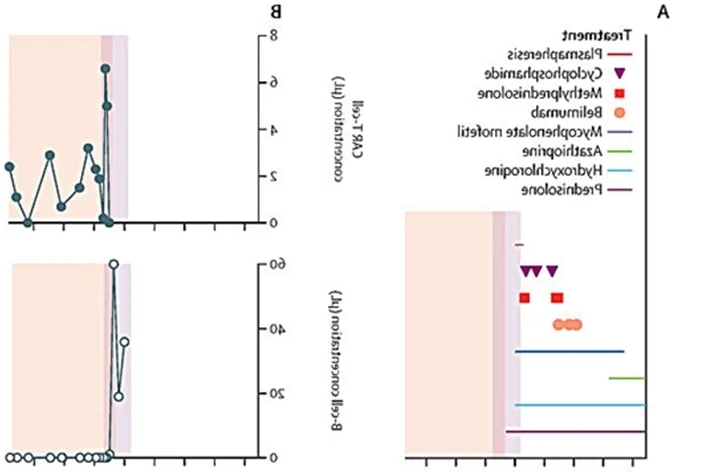
Image is from Lancet,2024,doi:10.1016/S0140-6736 (24) 00424-0
Furthermore, a large number of organizational and legal barriers must be overcome. The Fifth Department of Hematology and Oncology Medicine, Erlangen University Hospital, has a clean room laboratory for the production of CAR T cells as part of clinical research and individual treatments. After discussing this case in detail with colleagues, Professor Andreas Mackensen agreed to produce and use CAR T cells for this young patient.
Dr. Krickau stressed, " The whole treatment team has combined all this with their daily work in the hospital in a very short time. In accordance with the German Medical Products Act and the Medicinal Products Regulations, we initiated CAR T cell therapy for Uresas part of an extended use program for severe patients, called individual treatment attempts.”
Since 2021, a research team led by Dr. Georg Schett and Professor Mackensen, director of the Department of Rheumatology and Immunology, Erlangen University Hospital, has successfully treated patients with multiple autoimmune diseases (including SLE) using CAR T cells.
In February 2024, the team published 15 cases in New England Journal of Medicine journals as part of a pilot study; a CASTLE study with 24 participants is currently ongoing. All treated patients do well —— they are either healthy or have significantly reduced symptoms. This ultimately prompted the team to agree to CAR T cell therapy for Uresa.
UTeresa's mother, Albana A, said, " Dr. Fabian Muller and Professor Schett, senior doctors in the Department of Hematology and Oncology, Erlangen University Hospital, explained to us the efficacy of this treatment for adults and believed that it has great potential for Uresa."She recalled," But I'm afraid of losing her. She convinced me herself, saying,'I want to do this, you have to sign the form!’。The whole team worked very hard and did everything for my daughter.”
Previous treatments were not so effective
In the BMT ward of the Department of Pediatrics and Juvenile Medicine, Erlangen University Hospital, Uresa received a mild course of chemotherapy that made some room for CAR T cells in her blood. Professor Metzler explained, " The trick is to make sure that chemotherapy is done properly and not immediately washed away by dialysis, and to ensure that the remaining kidney function is not threatened.”
The important day came on June 26,2023: Uresa was transferred from the Department of Pediatric Oncology to the Fifth Department of Hematology and Oncology, Erlangen University Hospital, and received CAR T cell therapy specially modified for her.
Dr. Krickau said, " From the third week after this treatment, her kidney and lupus values have improved. We haven't achieved this effect with any drugs before."All of her symptoms had gradually disappeared.
At the end of July 2023, U-Teresa was finally able to go home and get her diploma. Her goal is to complete an apprenticeship in the auto industry, move out of the house soon, and have a dog. She was very happy, because she could meet her friends again, go out to play, and live a normal teenage life.
Professor Mackensen explained, " She also has plenty of CAR T cells in her blood. Because CAR T cells remove not only harmful B cells but also healthy B cells, meaning that Ures's body cannot normally defend against certain infections."Therefore, Uresa received an intravenous injection of vital antibodies every four weeks at the Erlangen University Hospital.
Dr. Krickau said, " The reason we avoided causing permanent damage to her organs was because we decided very early to use CAR-T cell therapy.”
Professor Schett stressed, " This success is entirely due to the close cooperation of doctors from multiple disciplines in the German immunotherapy center.”
Except for monthly intravenous immunoglobulin, Uresa no longer requires any medication or dialysis. Dr. Krickau said, " She was seriously ill, and now her kidneys have fully recovered, which no one can imagine.”
Today, Dr. Krickau is working with the Pediatric Oncology Department to plan research in other children and adolescents with autoimmune diseases, hoping to reach the great potential of CAR T cells in pediatric rheumatology.
reference material:
Tobias Krickau et al.CAR T-cell therapy rescues adolescent with rapidly progressive lupus nephritis from haemodialysis.Lancet, 2024, doi:10.1016/S0140-6736(24)00424-0.
World’s first CAR-T cell therapy for a child with lupus
https://www.fau.eu/2024/07/08/news/worlds-first-car-t-cell-therapy-for-a-child-with-lupus/
Our company's product recommendation:
1.7357-67-7 https://www.bicbiotech.com/product_detail.php?id=5400
2.184475-71-6 https://www.bicbiotech.com/product_detail.php?id=5401
3.761440-16-8 https://www.bicbiotech.com/product_detail.php?id=5402
4.614-19-7 https://www.bicbiotech.com/product_detail.php?id=5403
5.19947-39-8 https://www.bicbiotech.com/product_detail.php?id=5404