


Article source: EngineeringForLife
In vitro biological models are critical for a wide range of biomedical research, including drug development, pathology research, and personalized medicine. As a potential transformational paradigm for in-vitro 3D biological models, organ-on-a-chip (OOC) devices have been widely developed to recapitulate the complex architecture and dynamic microenvironment capabilities of organs by applying life science principles and using micrometer and nanoscale engineering. The key function of OOC devices is to support the timely analysis of living tissues and their microenvironment, so intelligent OOC systems have received increasing attention.
Recently, Xinyu Liu from the University of Toronto, Canada, together with Jiankang He from Xian Jiaotong University, discussed the latest progress of intelligent OOC (iOOC) systems, using sensors integrated with OOC devices to continuously report cellular and microenvironment information for comprehensive in situ bioanalysis (Figure 1). Multimodal data in iOOC systems can support closed-loop control of iOOC models and provide comprehensive biomedical insights for diverse applications.
The related review paper was published in Advanced Materials on 9 September 2023 under the title "Advancing Intelligent Organs-on-a-Chip Systems with Comprehensive in situ Bioanalysis".
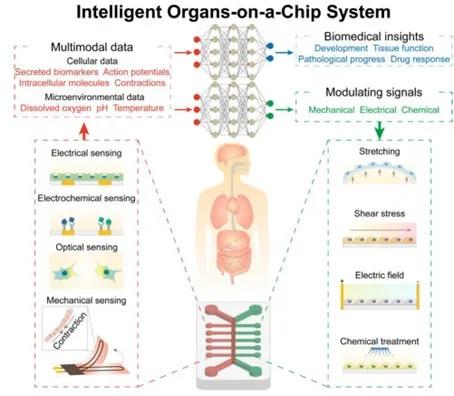
Figure 1 iOOC system diagram, iOOC system consists of in situ sensing, data processing and dynamic modulation components to achieve comprehensive bioanalysis
1. The evolution of OOC equipment to iOOC system
OOC technologies have been extensively developed to address the limitations of conventional 2D cell culture, such as the inability to construct heterogeneous cell populations and 3D tissue-specific structures of the extracellular matrix environment. OOC technology is derived from the integration of microfluidic and tissue engineering (Figure 2). Although the initial goal of tissue engineering was to regenerate human tissue, this technique has yielded various methods for constructing 3D tissue structures that may consist of extracellular matrix material, scaffold structures, and predefined compositions and arrangements of various cells. The main paradigm for designing OOC equipment is to reconstruct the composition of specific tissues and key aspects of the microenvironment, and microfluidic and tissue engineering technologies bring three key advantages to the development of OOC.
Due to the integration between sensors and OOC devices, intelligent OOC (iOOC) systems will emerge (Figure 1): Different sensing units constantly report the status of the OOC model and use the interrogation algorithm to process the data stream or modulate it using active components in the OOC device. The iOOC system can build more controlled, accurate and reliable in vitro models, and can deepen the understanding of physiological and pathological activities.
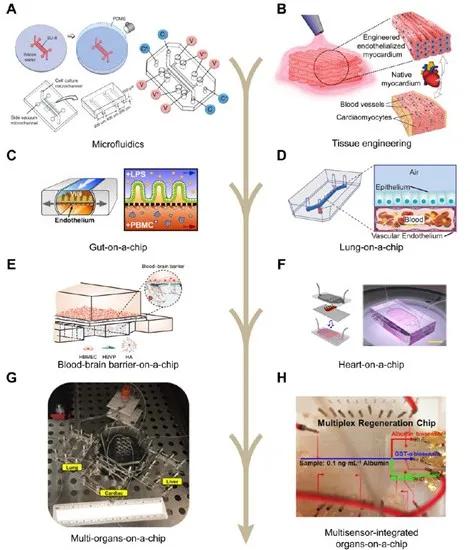
Figure 2 Evolution of the organ chip system
2. In situ sensing of the iOOC system
Various sensing units integrated with iOOC systems collect key biological information and generate data streams that lay the foundation for intelligent functions. In this section, the authors outline the integration approach for integrating the sensing unit into the iOOC system and then analyzing the sensing unit.
(1) Sensing technology of the iOOC system
Many methods have been established to convert the properties of the cell and microenvironment into electrical signals that can be easily processed with circuits. This section summarizes the in-situ inductance technique of the iOOC system based on electrophysiological signal recording and resistance and impedance measurements (Figure 3A). The electrochemical biosensors convert the biological information related to the electrochemical reaction into measurable electrical signals, such as changes in the conductance, resistance, and electrode surface capacitance (Figure 3B). In general, electrochemical biosensing mechanisms provide high specificity, wide dynamic range, easy quantitative electrical output as well as convenient integration. They are generally suitable for detecting molecular biomarkers pointing to multiple information. In particular, electrochemical biosensors integrated on an organ chip can detect multiple biomarkers in multiple ways. In addition, the optical sensing technology and mechanical sensing technology of the iOOC system are described in detail.
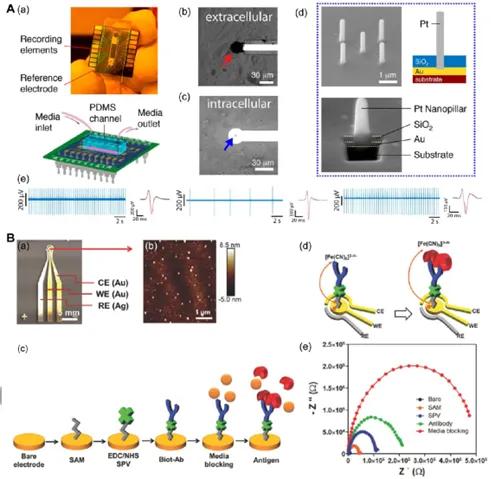
Figure 3 Electance mechanism of the iOOC system biosensing
(2) Strategy for integrating sensors into the iOOC system
The sensing unit should be seamlessly integrated with the iOOC system to continuously generate valuable data underpinning system intelligence. To achieve high performance monitoring, the sensing mechanism should be matched to the target and the sensor function should be robust in microfluidics, dynamic and organizational microenvironments involved because of the possible damping effects, altered ion distribution and other disturbances. Various strategies have been proposed to integrate the sensing unit into the iOOC system.there are mainly:
(i)Direct binding with tissues: sensing structures can establish contact and integration with living tissues or organoids in vitro to continuously record a variety of data reflecting the physiological states of these models. The authors summarized the forms of biosensing units integrated with living tissues, including discrete probes, 2D contacts, 3D wrapping, and 3D embeddings (Figure 4, Figure 5).
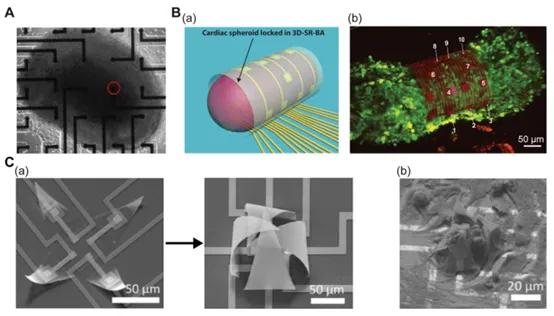
Figure 4 2 Sensor-tissue integration in D contact and 3D package
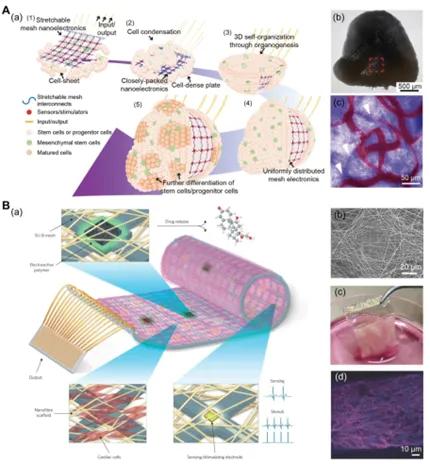
图5 3D嵌入形式的组织传感器集成
(ii)其他整合策略:
传感单元可以放置在微流体环境中,而无需直接接触组织,一种典型的方法是将传感单元合并到微流体通道或室中以监测培养基的状况;此外,传感单元可以制成可移动的以探测局部组织或培养基。
(3)在iOOC系统中感测多模态信息
iOOC系统中的组织模型构成了对生物医学有价值的复杂细胞信息的中心。在本节中,作者总结并讨论了有关生物标志物、细胞-细胞连接、生物电活动和生物力学活动的细胞信息的解释(表1)。
表1 在iOOC系统中感测细胞信息(部分)
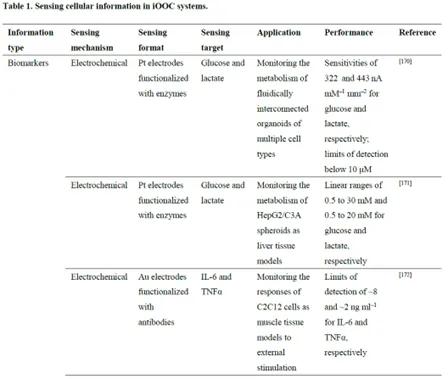
细胞培养微环境的准确监测和控制对于体外生物模型的成功至关重要,因为微环境的变化会影响细胞的代谢和功能表达。为了在体外尽可能准确地预测体内细胞或组织的反应,需要在iOOC系统中监测氧含量、pH值和温度等各种微环境信息(表2)。
表2 在iOOC系统中传感微环境信息(部分)

3. iOOC系统的数据处理
iOOC系统中数据处理技术的作用可以从两个方面来考虑。首先,数据处理可用于调整iOOC系统中的驱动部件,以确保精确调制并使系统更加自动化。其次,数据处理可以带来对发育、生理和病理过程的更多生物医学见解。在本节中,作者介绍了可用于处理iOOC系统生物分析数据的方法,包括图像分析、传感数据解释、自动化和数值模拟。
(1)iOOC系统的数据处理技术
作为人工智能和计算机科学的重要课题,机器学习算法直接从数据中解释信息,而不依赖于预定模型(例如指定的标准和校准曲线),通常用于分类、回归和聚类等工作(图6A-D)。分类本质上是将数据点分配给离散类别,回归生成连续值作为输出,聚类本质上预测数据集中相似数据点的分组。这些算法随着数据量的增加而提高其性能。
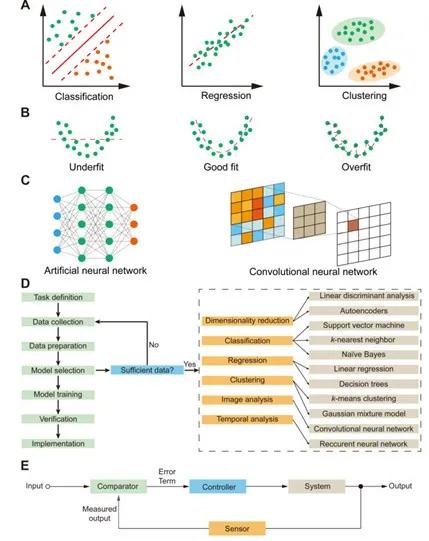
图6 iOOC系统的数据处理技术
(2)iOOC系统的数值模拟技术
可以采用有限元法、格子玻尔兹曼法、平滑粒子流体动力学等数值模拟技术来深入了解iOOC系统的物理和化学环境。数值模拟技术有助于消除重复实验测量(例如剪切应力和氧气分布)的需要,并允许以较低的成本优化iOOC系统。此外,这些技术可以提高对iOOC系统微环境中物理现象和组织行为的理解。
(3)iOOC系统的闭环控制技术
为了实现更高水平的质量控制并准确调整iOOC系统中的模型条件,可以利用依赖于传感器数据流的闭环控制(也称为反馈控制)技术。在工程设备广泛采用的闭环控制系统中,测量实际输出信号并将其与所需输出信号进行比较,以计算误差项,该误差项用于生成调整输入的控制信号(图6E)。
4. iOOC系统的动态调制
生物组织对其微环境中的各种外部刺激敏感,越来越多的研究证明,各种细胞-ECM和细胞-细胞相互作用可以导致广泛的组织特异性表型。iOOC系统为加深对这种复杂相互作用的理解提供了新的机会,因为可以部署集成到这些系统中的调节组件来控制微环境并调整组织模型以代表生理和病理条件。iOOC系统中的某些组件可以执行传感和调制的综合功能,支持iOOC模型的双向原位表征,以揭示更深入的生物医学见解。
(1)iOOC系统的机械载荷:在具有动态细胞培养环境的OCC系统中应用机械载荷对于在体外建立类组织的生理微环境至关重要。为了产生动态拉伸和压缩,通常需要专门的机械结构和驱动机制,而在OOC设备中可以通过控制流体动力学来精确调节剪切应力(图7)。
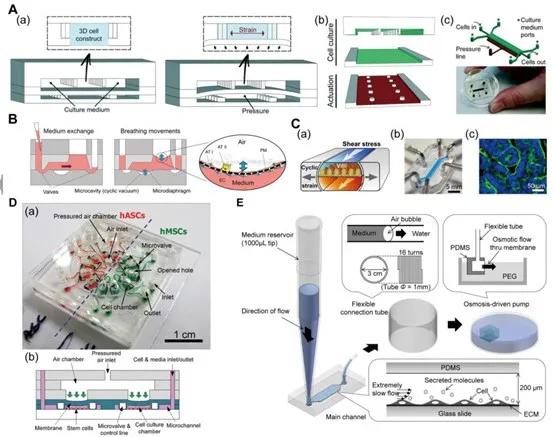
图7 iOOC系统中的机械调制原理图
(2)iOOC系统的电刺激:多种细胞行为受到内源电流和电位的调节,因此iOOC系统中经常需要电刺激。为了产生特定目的的可控电刺激,需要仔细配置相应的电元件。许多结合电刺激的OOC设备被设计用于研究肌肉、心脏和神经系统(图8A)。
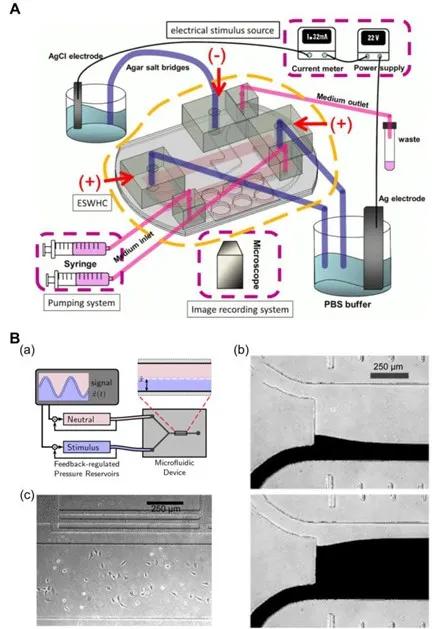
图8 iOOC系统中的电气和化学调制原理图
(3)iOOC系统的化学处理:准确的体外生理模型通常需要时间和空间可控的化学环境。通过微流体技术,可以在整个装置的可调节流体流量内精确控制化学相互作用和分布,以匹配与细胞成分相同的规模。微流体装置中可以使用化学信号发生器,向细胞引入随时间变化的化学信号,以便研究组织对动态变化的化学信号的反应(图8B)。
5. 未来展望以及结论
(1)传感单元
iOOC系统中生物传感单元的未来发展可以充分利用生物传感器和生物电子学领域的新兴技术和策略。在传感材料和制造方法方面研究进展的推动下,生物传感器和生物电子学正在获得越来越强大的能力,例如高灵敏度、高小型化以及与活体组织改善的机械相容性。因此,它们更适合集成到iOOC系统中。
(2)数据处理
随着iOOC系统的不断发展,将培养、维护、监测和调节各种各样的组织模型,这将构成有价值的生物医学数据的重要来源。例如,iOOC系统可以形成具有不同细胞组成和微环境的组织模型以模拟特定疾病状况,并且iOOC系统可以支持对组织模型的不同区域进行各种连续生物分析以检测空间异质性。此外,iOOC系统的多模态传感数据可以与组织模型的多组学数据相关联,以对生物机制产生更深入、更全面的理解。
(3)调节单元
iOOC系统中的调节单元可以通过利用技术发展和生物医学研究的进步来寻求更深入的组织整合和更有效的扰动,如软生物电子元件、新型微米和纳米级结构等。
(4)智能芯片人系统
连接不同器官微型模型的人体芯片设备的出现,为研究人体器官的复杂相互作用和获得对生理学和病理学的系统见解提供了可能性。当iOOC系统集成人体芯片模型时,由多个传感器支持的原位生物分析可以增强这些模型充分发挥其潜力。
(5)iOOC系统的标准化
质量控制已被OOC技术研发界视为一项关键任务,非常需要OOC设备的标准化,以对临床实践和制药行业产生重大影响iOOC系统的发展可能会对标准化产生多方面的影响。
文章来源:
https://doi.org/10.1002/adma.202305268
本公司产品推荐:
1.83674-70-8 https://www.bicbiotech.com/product_detail.php?id=5530
2.677702-58-8 https://www.bicbiotech.com/product_detail.php?id=5531
3.259209-22-8 https://www.bicbiotech.com/product_detail.php?id=5532
4.155601-65-3 https://www.bicbiotech.com/product_detail.php?id=5278
5.1227599-35-0 https://www.bicbiotech.com/product_detail.php?id=5534