


01, and second-generation sequencing by NGS
NGS, Next Generation Sequencing, is also known as high-throughput sequencing or deep sequencing. NGS is a revolutionary DNA or RNA sequencing technology that enables the simultaneous sequencing of multiple DNA or RNA molecules in a relatively short period of time, thus enabling a comprehensive analysis of the genome, transcriptome, epigenome, etc.
Compared with the traditional Sanger sequencing technology, NGS has the advantages of higher throughput, faster speed and lower cost:
-Parallel sequencing: simultaneous sequencing of millions of DNA fragments
-High throughput: rapid generation of large genomic data (3 Mb-30 Gb / day)
-Cost-effective: achieving comprehensive sequencing at a lower unit base cost

NGS technology is based on different principles and platforms, but its basic workflow consists of the following steps:
Library preparation: Sample DNA or RNA is extracted and converted into a library, including library construction, fragmentation, and appropriate sequence addition.
Sequencing: DNA or RNA fragments from the library are immobilized on the platform and subjected to massively parallel sequencing reactions. Different NGS platforms use different sequencing principles, such as chemical fluorescent labeling (e. g. Illumina), nanopore (e. g. Oxford Nanopore), or semiconductor chips (e. g. Ion Torrent).
Data analysis: The raw data obtained from sequencing is transmitted to the computer for processing and analysis. This includes a series of bioinformatics analysis steps, including data quality control, sequence alignment, variant detection, and gene expression quantification.
NGS technology has been widely used in genomics, transcripomics, proteomics, epigenetics and other fields, and has promoted many major breakthroughs in the life sciences, such as the Human Genome Project, cancer genomics, microbiome, etc. The development of NGS has also revolutionized personalized medicine, precision medicine, and agricultural genomics.
02. NGS market development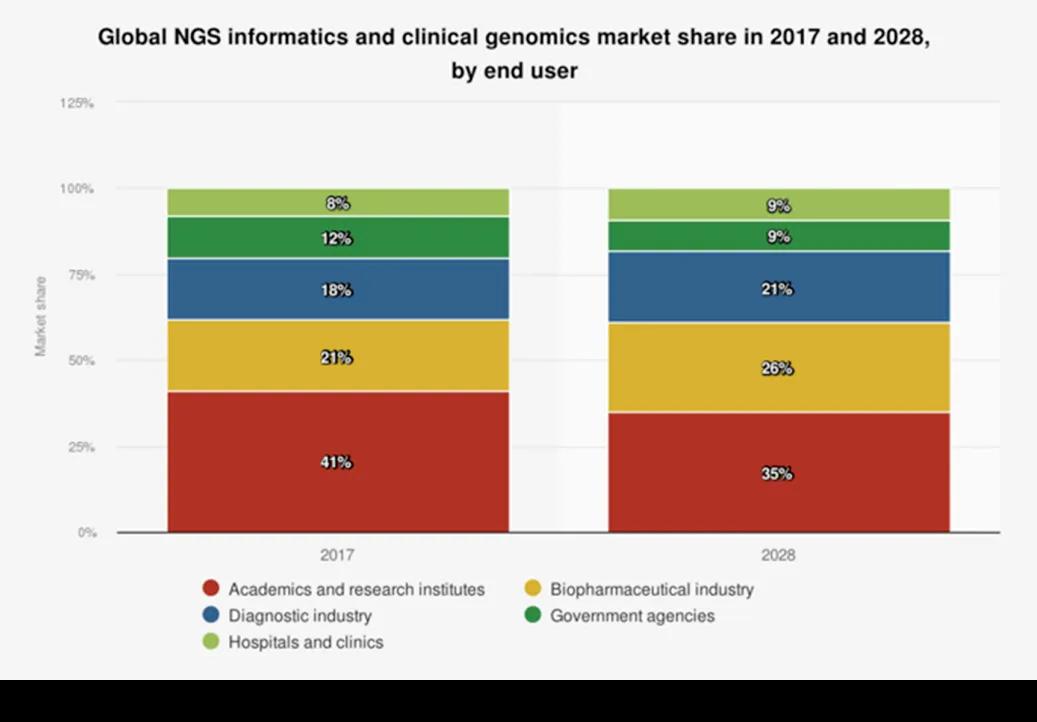
Overall, NGS technology has been from scientific research to clinical, become one of the important tools in the field of health care, can help people understand the genetic structure and the susceptibility of various diseases, through the identification of pathogenic variation, implementation of cancer, infectious diseases, rare genetic variation, prenatal abnormalities and may affect the treatment response of drug gene variation early accurate detection, so as to greatly improve the treatment effect of patients.
The main technologies of NGS currently include the following:
1. 454 sequencing technology: 454 sequencing technology is a sequencing technology based on series synthesis reaction (Sequencing by Synthesis, SBS) developed by Roche company, which uses the process of fluorescent signal to detect DNA synthesis to achieve DNA sequencing. Although the current share of 454 technology in the NGS market is already small, but it still has a certain market demand in some specific application areas.
2. Illumina sequencing technology: Illumina is one of the most widely used technologies in the NGS market. The rationale is to of DNA synthesis, amplification and sequencing to achieve high-throughput DNA sequencing. The Illumina technology has a high degree of accuracy, reliability and throughput, and is suitable for whole genome sequencing, transcriptome sequencing, and methylation analysis.
3. Ion Torrent sequencing technology: Ion Torrent technology is a sequencing technology based on semiconductor chip, using the DNA sequencing method without chemical fluorescence tag. With a simplified workflow, short experimental period and low equipment cost, Ion Torrent sequencing technology is suitable for small-scale laboratory and clinical diagnostic applications.
4. PacBio sequencing technology: PacBio technology adopts single-molecule real-time sequencing (Single Molecule Real-Time, SMRT) technology, which can realize long-read and long-length DNA sequencing. PacBio Technology is characterized by high read length and low error rate, and is suitable for structural genomics, complex genomes structure analysis and other fields.
5. Oxford Nanopore sequencing technology: Oxford Nanopore technology is a technology based on the principle of nanopore sequencing to realize DNA or RNA sequencing through the passage of nucleic acid molecules in the nanopore. ONT technology is characterized by real-time sequencing, portable equipment and long read length, and is suitable for field environment, rapid diagnosis and mobile medical applications.
These main NGS technologies have their own characteristics and advantages, and are suitable for different experimental purposes and application scenarios. As technologies continue to develop and innovate, the technologies and platforms in NGS are constantly updated, providing richer and more powerful tools for scientific research, clinical diagnostics and the biological
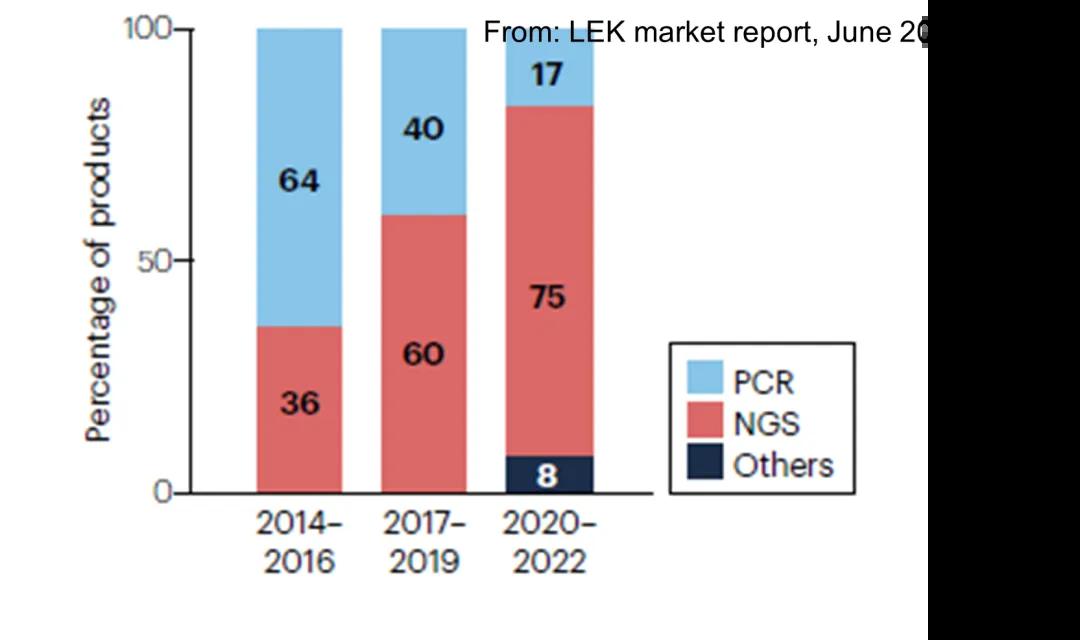
As Solexa / Manteia / Illumina patents begin to expire, it is bound to have an impact on the development of the NGS market, which may include:
-Updated NGS platform
-Reagent pricing pressure to Illumina
-Develop new (or newer) technologies using new reagents
03, the obstacles in NGS application

A recent article in Nature Medicine (Nature Medicine) states that 86% of genomics studies are conducted in European descent 1, highlighting the wide global gap in the availability and accessibility of genetic testing.
Thus, the currently available genomic data lacks representation from all populations to capture genetic diversity across different ethnic and geographic regions. Many diseases will vary in terms of prevalence, severity, and response to treatment according to genetic factors influenced by race and ancestry. Without adequate representation, the effectiveness of genomic studies in addressing the genetic basis of disease in non-European populations can be greatly limited.
To achieve the broad application of NGS, several obstacles must be overcome to improve its affordability and accessibility. A single human genome cost over $10 million in 2007,2 and although overall affordability has improved since then, low-income countries may still cost five times more than high-income countries due to taxation and the high cost of analysis, transportation and infrastructure. Specifically, challenges in low-income countries include sample processing coordination, reagent costs and procurement, quality assurance procedures, and data management.
From an ethical perspective, it is also necessary to ensure that the benefits of genomic research are fairly distributed and that marginalized groups are not utilized. While working to democratize NGS technology and genomic data access, it is best to take steps to address gaps in healthcare access, promote inclusion, and prioritize the needs and perspectives of vulnerable populations.
04. NGS progress and technological development

The future development direction of NGS technology includes the following aspects:
1 and the development of single-cell sequencing technology
2. Improvement of long-read long-sequencing technology
3. Progress of real-time sequencing technology
4. Multi-omics data integration and analysis
5. Development of portable and miniaturized POC devices
6. Application of artificial intelligence and machine learning in data analysis
In general, the future development direction of NGS technology will be higher throughput, higher resolution, portability and intelligence to meet the growing scientific and clinical needs, and bring more breakthroughs and innovations to the life sciences.
Software and hardware-software advances have enabled laboratories of all sizes to be sequenced at faster rates and lower prices to drive the expansion of the NGS market and its use in new environments. The price of sequencers suitable for low sample size is comparable to that of users with high sample size, reducing the centralization degree of sequencing, and improving the democratization degree and control ability of samples and the generated data.
In particular, the new sequencing technology enables products to be transported and used without cold chain or temperature-controlled logistics, compatible with portable POC devices, which will address key challenges facing many countries as cold chain logistics can be costly, complex and sometimes unusable in resource-limited settings. Enabling local laboratories to perform their own NGS tests without having to send samples to other countries, minimizing costs overall, accelerating delivery cycles, and reducing sample processing logistics.
In conclusion, as NGS technologies continue to fall, new applications will continue to expand, and the integration of new tools such as cloud NGS informatics platforms, machine learning and AI will further drive its role in global healthcare change.