


Organ-on-a-chip (OOC) is an emerging technology to simulate artificial organs within a microfluidic cell culture chip. Current cell biology studies focus on in vitro cell culture, due to various limitations of in vivo experiments. In vitro cell culture cannot provide an accurate microenvironment, and in vivo cell culture is expensive. The goal of OOC is to overcome these shortcomings and provide the best in vitro and in vitro cell culture studies. A key part of the OOC design is the use of microfluidics to ensure stable concentration gradients, dynamic mechanical stress modeling, and precise reconstruction of the cellular microenvironment. OOC also has the advantage of fully observation and control system, which is not possible to reproduce in in vivo studies. Multiple throughput, channels, membranes, and chambers were constructed in a polydimethylsiloxane (PDMS) array to simulate the various organs on the chip. Various experiments can be performed using OOC techniques, including drug delivery studies and toxicology. Current technological extensions involve multiple organ microenvironments on a single chip, allowing the study of tissue interactions.
Development of organ-chip technology
The concept of organ chip technology first appeared in the late 1990s. With the progress of microfluidic technology and bioengineering technology, the research of organ chip gradually changed from theoretical exploration to practical application. Early organ chips were mainly used to simulate a simple cellular environment, and with the continuous development of technology, the current organ chips have been able to simulate complex human organ functions.
Early stage of development
In the early stage, organ chips are mainly based on 2 D cell culture, using microfluidic technology. Despite the advantages of these early chips in simulating the cellular microenvironment, their functions and applications remain limited.
technical breakthrough
With the development of 3 D cell culture technology, the organ chip technology has made important breakthroughs. Three-dimensional culture can better simulate the organ stereo structure and function, improving the physiological relevance of the organ chip. Moreover, developments in tissue engineering and biomaterials science have also provided support in organ-chip advances.
The rise of multi-organ chips
In recent years, the concept of multi-organ chip (multi-organ-on-a-chip) has been gradually proposed and practiced. Such chips simulate the interaction of multiple organ systems in the human body by integrating multiple different organ models on the same chip, providing new tools for drug screening and disease research.
01, the kidney chip
The kidneys expel waste products and excess water in urine and help maintain the chemical balance of sodium, potassium and calcium in the body. They also produce hormones that help control blood pressure and stimulate the bone marrow to produce red blood cells. For the first time, researchers used mouse kidney cells to create a multilayer microfluidic system that simulates kidney filtration. The same device was later used to grow human renal cells; this is one of the first toxicity studies of primary renal epithelial cells. Some researchers have made a renal chip that simulates the structure and function of the capillary wall, as shown in Figure 1. Mechanical pressure on the battery layer can be generated through the vacuum chamber on either side. Many other studies revolve around disease modeling, drug screening, and toxicological assessment.
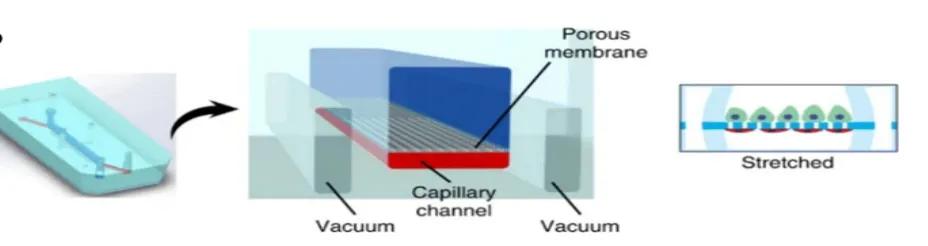
Figure 1. Kidney Chip.
02. Lung chip
Gas exchange in the human lungs is regulated by the alveoli, small pockets that allow blood to exchange oxygen and carbon dioxide during respiration. This process has been challenging to replicate in vitro. However, OOC technology enables researchers to create precise lung microenvironments to maintain consistent gas exchange. The current study has mainly focused on the regulation of mechanical airway pressure and the blood – brain barrier. Some investigators have constructed a subregional lung microenvironment, as shown in Figure 2. The upper parts are alveolar cells and the lower parts are lung cells; this simulates the alveolar-capillary barrier. The system operates in a vacuum to simulate the expansion and contraction of the alveoli during respiration. Inflammatory stimuli are also introduced into the system in the form of neutrophils via fluid channels.
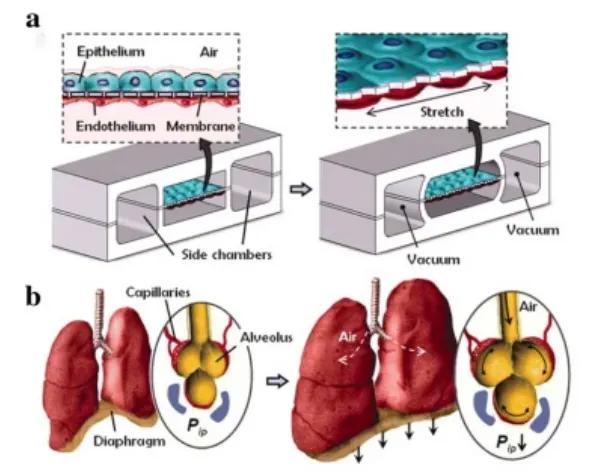
Figure 2. Lung Chip.
03, the heart chip
Microfluidics have enabled new studies of cardiac tissue. The myocardium is the muscle tissue of the heart; the anatomical unit of the myocardium is the heart cell (cm). Some researchers have designed a platform to simulate the physiological and mechanical microenvironment of the heart, as shown in Figure 3. Pressure of the lower chamber deformed the separation membrane and compressed the 3 D structure to mimic heart beating.

Figure 3. Cardiac chip.
04, multiple-organ chip
The human body is complex, and a single organ chip cannot fully and accurately reflect the human organs, but cannot identify the interaction of the organ with other organs and systems in the body. The "multi-organ chip" (multi-organ-on-a-chip), also known as the "human chip" (human-on-a-chip), is an ongoing research project that can build multiple organs on a single chip simultaneously, as shown in Figure 4. Theoretically, connecting different organs and tissues through bionic blood channels can realize multi-organ integrated interaction.
In drug safety, there are a variety of challenges to overcome. Two-dimensional culture and animal studies do not truly represent the human body. The liver metabolizes drugs, produce compounds that may cause unpredictable toxicity to some organs (such as the heart). Several liver and cardiac models have been widely used to evaluate the toxicity of new drugs or recalled drugs. The multi-organ chip-on-chip platform provides an innovative approach to study drug-related effects to predict hepatic metabolism in non-target organs and ultimately improve drug safety testing during the preclinical development phase.
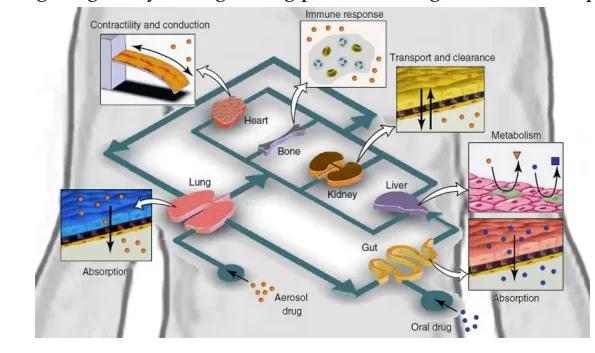
Figure 4. Human body chip.
The principle of the organ chip
Microfluidic technology
Microfluidic technology is the core of the organ chip, enabling the precise control of liquid flow through micron-level channels. This technique can simulate the flow of blood in organs, providing a stable supply of nutrients and metabolic waste exclusion.
Three-dimensional cell culture
Organ chips typically employ three-dimensional cell culture techniques to mimic the real structure and function of the organ. Three-dimensional culture is able to provide a cell growth environment closer to physiological conditions and improve the physiological relevance of experimental results.
biological materials
The matrix materials of organ chips are usually biocompatible materials, such as water gel, polydimethylsililoxane (PDMS), etc. These materials are able to support cell adhesion, growth, and differentiation.
transducer technology
Various sensors are usually integrated on the organ chip to monitor the physiological state of the cell and the microenvironmental parameters in the chip. These sensors are able to provide real-time data on cell growth, metabolism, and response.
Application of the organ chip
drug screening
Organ chips can simulate the microenvironment of human organs for the screening of new drugs and efficacy evaluation. Compared with traditional in vitro cell culture and animal experiments, organ chips can provide drug response data closer to the human body, and improve the efficiency and accuracy of drug screening.
The disease model
Organ chips can be used to build various disease models, such as cancer, cardiovascular diseases, and neurological diseases. By simulating the disease pathogenesis, organ chips provide a new platform for disease research and the development of new therapies.
Personalized medicine
By using patient-derived cells, organ chips can be used in personalized medicine research. Doctors can use organ chips to test different treatment options according to the patient's specific situation, so as to develop the most appropriate personalized treatment strategy.
Toxicity test
Organ chip technology can be used to assess the toxicity of chemicals, drugs and food additives, etc. Organ chips can provide more accurate and reliable toxicity data than traditional toxicity testing methods.
regenerative medicine
Organ-chip technology also has important applications in regenerative medicine. By simulating the developmental and regeneration processes, organ chips can be used to study key issues in tissue engineering and regenerative medicine, such as stem cell differentiation, tissue repair, etc.
Future prospects of organ-chip technology
Standardization and normalization
In order to promote the wide application of organ chip technology, unified standards and norms need to be established. This will help the data comparison and technical communication between different research teams, and promote the development of organ chip technology.
Improvement of the chip material
Develop more biocompatible and functional materials to improve the performance and stability of the organ chip. These new materials will help to achieve longer periods of cell culture and more sophisticated organ models.
Integration of multiple-organ systems
To realize the integration of multiple organ systems on the same chip to better simulate the interactions of human organs. This will provide new tools for systemic drug screening and complex disease research.
Artificial intelligence and big data
Combining artificial intelligence and big data technology, the large amount of data generated by the organ chip is analyzed and mined. This will help to discover new biological laws and drug targets, and improve the research efficiency.
sum up
As an emerging biomedical engineering technology, organ chip technology has broad applications. By simulating the microenvironment of human organs, organ chips provide new tools for drug screening, disease research, and personalized medicine. Despite some challenges, as the technology continues to develop and improve, the organ chip is expected to play a more important role in future biomedical research.
reference documentation:
Negar Farhang Doost,S.D.Srivastava.A Comprehensive Review of Organ-on-a-Chip Technology and Its Applications in Disease Diagnostics.null.2024;0 (0):0-0. doi:10.20944/preprints202403.0965.v1